Article Library

The Hickey four-step process — and the seven cases that matter for your super split.

Long-form, plain-English articles on the leading FamCA and FCFCOA decisions on superannuation splitting and pre-relationship contributions. Read one, then run your numbers.

Foundational
Article 01 of 8

Hickey & Hickey & Attorney-General for the Commonwealth

[2003] FamCA 395 · Full Court of the Family Court of Australia

Sets the four-step methodology applied in every Australian property settlement, including those involving superannuation splits under Part VIIIB.

Step 1 — Identify and value the property

The Court must first identify all assets, liabilities and financial resources of both parties as at the date of hearing (not separation). Superannuation interests are 'property' for Part VIIIB purposes and must be valued under the Family Law (Superannuation) Regulations 2001 — accumulation interests at member balance, defined benefit interests using the prescribed scheme-specific or default factor.

Step 2 — Assess contributions

The Court weighs financial contributions (s 79(4)(a)), non-financial contributions (s 79(4)(b)) and homemaker / parent contributions (s 79(4)(c)). Pre-relationship superannuation enters here as an initial financial contribution. The actuarial 'roll-forward' of that opening balance to today's dollars is the evidence the Court relies on.

Step 3 — Section 75(2) future-needs factors

Age, health, care of children, earning capacity, and crucially — disparity in superannuation balances at retirement age — are weighed. A small s 75(2) adjustment in favour of the lower-balance party is common, but it operates after Step 2, not in place of it.

Step 4 — Just and equitable

The Court stands back and asks whether the resulting orders are 'just and equitable' under s 79(2). Stanford v Stanford (2012) 247 CLR 108 reinforces that this is an independent threshold — not a rubber stamp.

Why this matters for your matter

If you brought super into the relationship and cannot put a defensible Step-2 number in front of the Court or your mediator, your initial contribution will be assessed at zero. Run the estimator to see your indicative grossed-up figure, then consider commissioning a fixed-fee report.
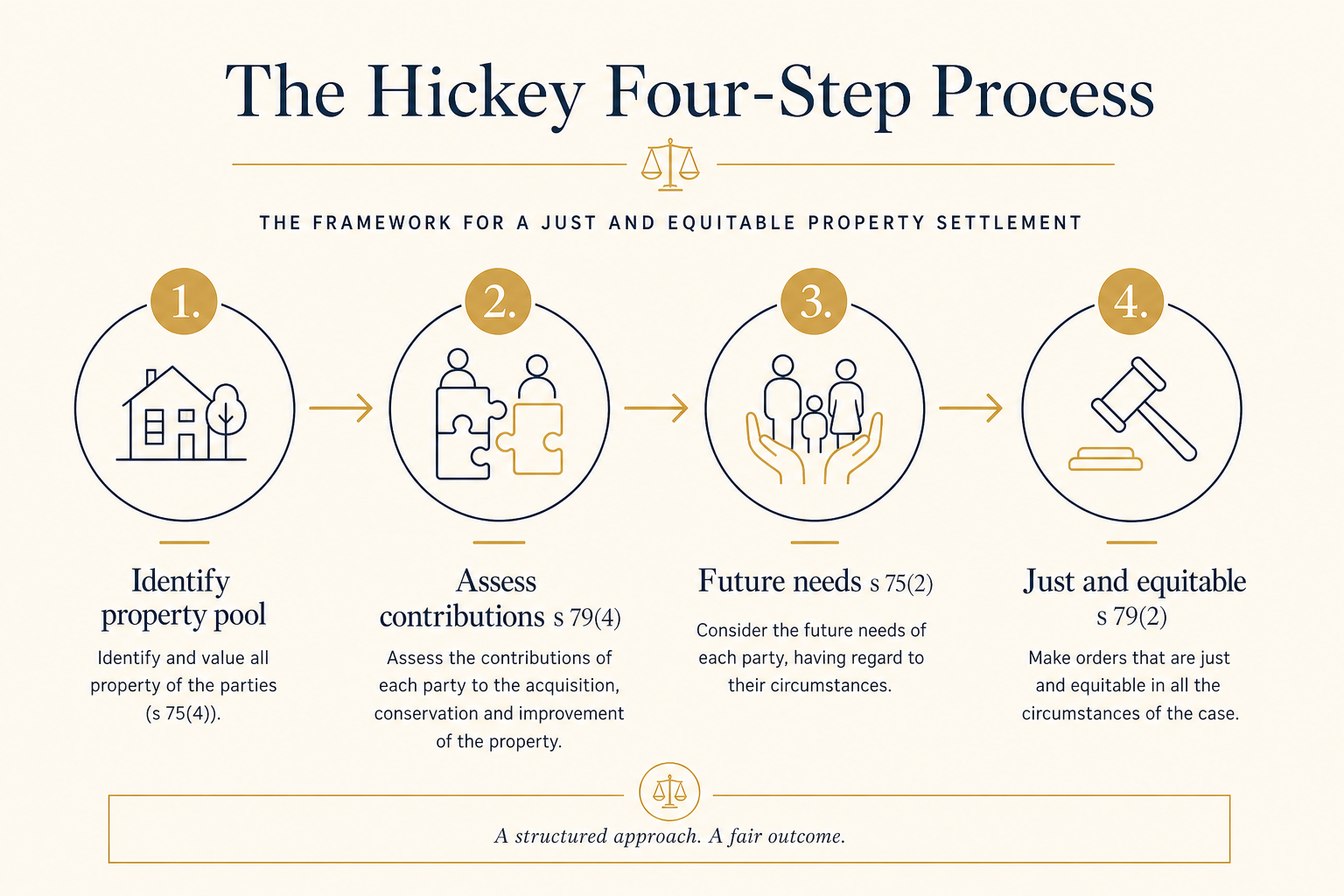
Diagram of the Hickey four-step family law property settlement process: (1) identify and value the property pool under s 75(4); (2) assess contributions under s 79(4); (3) consider future-needs factors under s 75(2); (4) make orders that are just and equitable under s 79(2).
The four-step Hickey framework — every superannuation split flows through these steps.

Quantify your Hickey argument with a defensible number.
Open the estimator
Two-pool approach
Article 02 of 8

Coghlan & Coghlan

[2005] FamCA 429 (Full Court) · Full Court of the Family Court of Australia

Authorises a 'two-pool' treatment of superannuation where contributions to super differ materially from contributions to the non-super pool.

What the Full Court decided

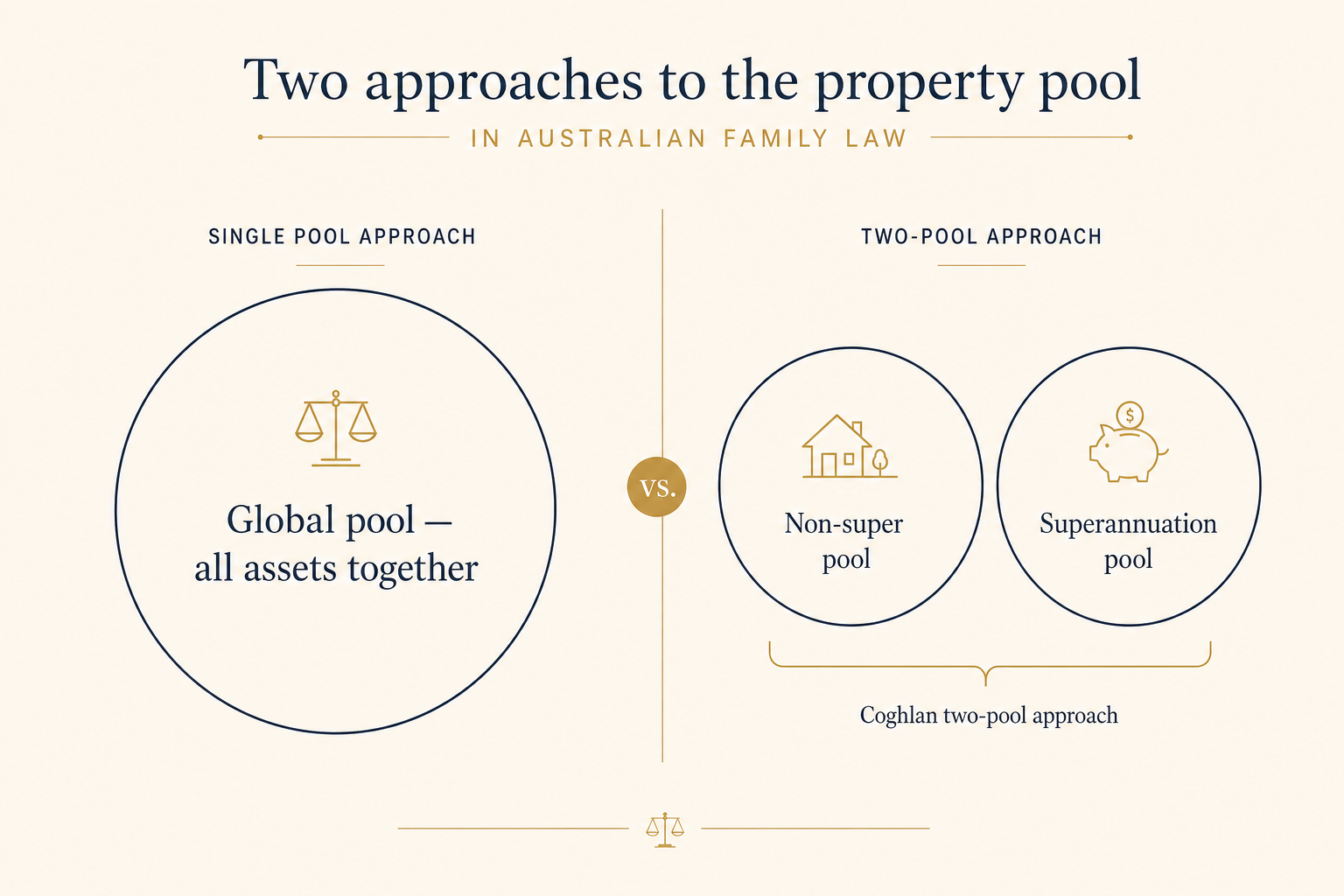
Where the parties' contributions to superannuation are clearly different from their contributions to non-super assets, treating super as a separate pool produces a fairer Step-2 assessment than a single global pool. The Court is not required to use two pools — but it may, and often should.

Practical impact on pre-relationship super

If one party brought significant super into the relationship and the other did not, Coghlan provides the doctrinal hook for quarantining that initial contribution inside its own pool — preserving its weight rather than diluting it across the family home and savings.

When to argue Coghlan

Long relationship, broadly equal non-super contributions, but materially unequal super at cohabitation. Use the estimator to quantify the gap before you raise it in mediation.

Diagram comparing the single global pool approach with the Coghlan two-pool approach in Australian family law, showing superannuation treated as a separate pool from non-super assets where contributions are materially disproportionate.
Coghlan: super may be treated as its own pool when contributions are materially disproportionate.

Quantify your Coghlan argument with a defensible number.

Open the estimator
Initial contributions
Article 03 of 8

Pierce & Pierce

(1999) FLC 92-844 · Full Court of the Family Court of Australia

The foundational authority on how initial financial contributions are weighed throughout a long relationship.

The Pierce principle

The Full Court held that an initial contribution is not assessed by its dollar value at the date of contribution, nor by its compounded value at trial — it is assessed in the context of all contributions made by both parties over the whole relationship. Critically, the contribution is given 'full weight' first, before being weighed against subsequent contributions.

How Pierce applies to super

Pre-Part VIIIB, super was excluded from property. Pierce was decided in that context but its reasoning has been applied repeatedly to super since 2002 — most recently in Holland and Jabour. The actuarial roll-forward of pre-cohabitation super to today's dollars is precisely the evidence that lets the Court give 'full weight' to the contribution.

Quantify your Pierce argument with a defensible number.

Open the estimator
Modern restatement
Article 04 of 8

Holland & Holland

[2017] FamCAFC 166 · Full Court of the Family Court of Australia

Modern Full Court authority confirming that the passage of time does not extinguish an initial financial contribution.

What Holland reaffirms

Where a party brings substantial property (including superannuation) into a relationship, that contribution is not 'eroded' by the length of the relationship alone. The contribution must be given full weight at Step 2 and only then weighed against the other party's subsequent contributions and s 75(2) factors.

Use this against the 'it was 20 years ago' argument

A common opposing position is that long relationships dissolve initial contributions into the joint endeavour. Holland is your direct rebuttal — provided you have an actuarial report quantifying the contribution.

Quantify your Holland argument with a defensible number.

Open the estimator
Asset-by-asset
Article 05 of 8

Jabour & Jabour

[2019] FamCAFC 78 · Full Court of the Family Court of Australia

Endorses asset-by-asset assessment where contributions to a particular asset (including super) differ materially from contributions to the rest of the pool.

The asset-by-asset approach

Jabour confirms that, in appropriate cases, the Court can assess contributions on an asset-by-asset basis instead of pooling globally. This is the appellate companion to Coghlan and is the doctrinal basis for separating out a super interest with a heavy pre-relationship slice.

What this means in practice

Cite Jabour to a registrar, mediator or other side who insists on a single global pool. Combined with Coghlan, it provides the modern Full Court framework for ring-fencing pre-cohabitation super.

Quantify your Jabour argument with a defensible number.

Open the estimator
Roll-forward methodology
Article 06 of 8

Charney & Charney

[2009] FamCA 751 · Family Court of Australia

Direct authority that actuarial 'roll-forward' valuation of pre-cohabitation super is judicially accepted.

What the Court accepted

Expert actuarial evidence valued the husband's super at the date of cohabitation and rolled it forward to separation using the actual fund crediting rates. The grossed-up amount was treated as a discrete s 79(4)(a) initial contribution and effectively quarantined.

Why this case matters to you

Charney is the case to cite if anyone tells you the roll-forward methodology is 'not how the Court does it'. It is exactly how the Court does it — when properly evidenced.

Line chart of the actuarial roll-forward methodology used to gross up pre-relationship superannuation from cohabitation date to separation date using net-of-fees fund returns, producing a section 79(4)(a) initial contribution figure.
Roll-forward: the cohabitation balance grossed up to today's dollars using actual fund returns.

Quantify your Charney argument with a defensible number.

Open the estimator
Long marriage
Article 07 of 8

Clough & Clough

[2007] FamCA 174 · Family Court of Australia

Long marriage with substantial pre-relationship super — the time-value of the initial contribution was recognised and the percentage split adjusted accordingly.

Key holding

The Court declined to treat the husband's substantial pre-relationship super as eroded by the length of the marriage. Instead it gave full weight to the initial contribution and adjusted the percentage division of the super pool accordingly.

Use case

Marriages of 15+ years where one party entered with materially more super. Clough is the on-point first-instance authority complementing Pierce and Holland.

Quantify your Clough argument with a defensible number.

Open the estimator
Defined benefit
Article 08 of 8

Trent & Jollie

[2014] FamCA 544 · Family Court of Australia

Treatment of defined benefit interests where part of the member's service pre-dated cohabitation.

Service-based apportionment

The Court apportioned the defined benefit interest by reference to service-based formulas — not by a simple percentage of the gross value. The pre-relationship service slice was treated as a discrete s 79(4)(a) initial contribution.

Implications for PSS, CSS, military and state schemes

If you are a member of a defined benefit scheme (Commonwealth PSS / CSS, MSBS / DFRDB, state schemes), a service-weighted apportionment is mandatory. A simple 'value at cohabitation ÷ value at separation' calculation will undervalue your initial contribution.

Quantify your Trent argument with a defensible number.

Open the estimator

Reading the cases is step one. Quantifying your contribution is step two.

Our free estimator gives you an indicative grossed-up figure in 60 seconds. A fixed-fee expert report turns it into evidence the Court will accept.